Monday, 22 April 2013
League workshop by Germaine Koh 1
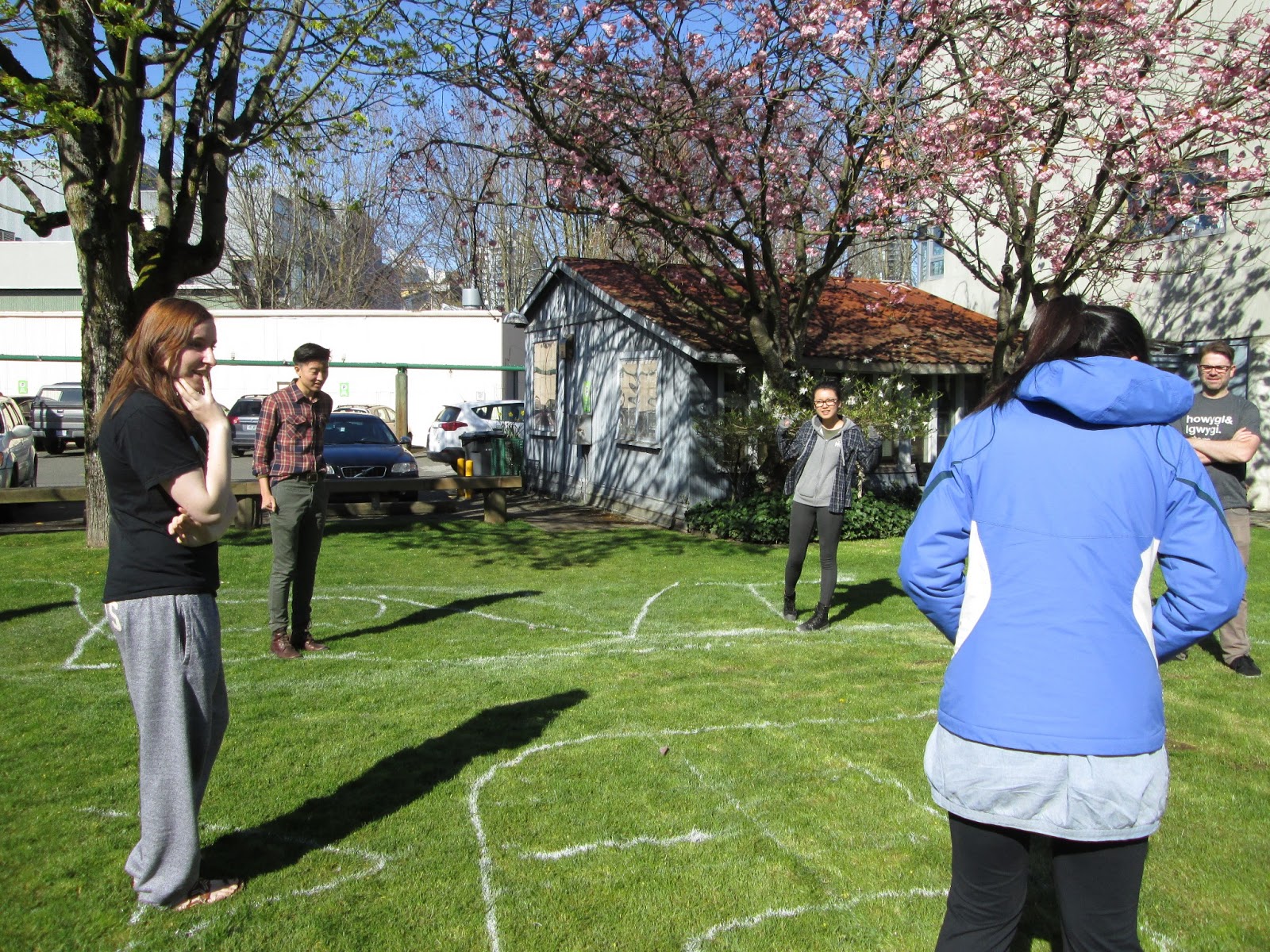
After the presentation, we started to invent new games by mixing existing games or improvising as it goes.
League workshop by Germaine Koh 1
League Part 1
April 14
Vancouver based, internationally renown artist Germaine Koh's project League is a part of Fieldhouse residency program run by Vancouver Park Board. When I learned about League through her presentation at the symposium on community and art last fall at Emily Carr University of Arts, I immediately thought it'll be a great exercise to bring in.
April 14
Vancouver based, internationally renown artist Germaine Koh's project League is a part of Fieldhouse residency program run by Vancouver Park Board. When I learned about League through her presentation at the symposium on community and art last fall at Emily Carr University of Arts, I immediately thought it'll be a great exercise to bring in.
"League is an open group of people who gather to play sports and games invented by members of the community. Each game, its equipment, its playing field, and its strategies evolve through trial and improvisation. It’s problem-solving as play."
Germaine and Bruce Emmet, a regular leaguer, artist and a teacher, started with a slide presentation about art and game. As we couldn't see the slides well in the studio due to the skylight, I'm posting them here.
Friday, 19 April 2013
Some inspiring installation
Installation is a genre on its own, but even when it is not, how you display your work can be a big part of fabrication.
Mark Peter Wright, 30 minutes of listening
Ed Ruscha, Blue color Tech-chem
Thursday, 11 April 2013
Drawing and game: Olivia Plender
Many artists have been interested in the topic of game, and here's one example (that is not sporty). Olivia Plender is a London-based artist and was one of my tutors while I was studying there. I'm copying her article on drawing from The Guardian with her meticulous drawing.
Set Sail for the Levant, 2007, board game, 50 x 50cm. Courtesy of Olivia Plender
I have been drawing since I was a kid. It was my first creative outlet before I discovered the other possible ways of making art. I returned to drawing in a big way about 10 years ago after I first left art school. My practice has evolved in a more complicated direction, involving a lot of historical research, which usually ends up in performances, installations and videos but I find that drawing is still a necessary part of the process.
Drawing is fantastic because it is a cheap and immediate way of making work. All you need is a pencil and a piece of paper. When I first left art school I wanted to make films, but I had neither studio nor money so I made comics instead. In my mind I was making cheap films – I was using a cinematic visual language on the page, exploring narrative, mis-en-scène and how words and images relate to each other.
One of my first influences was the work of Öyvind Fahlström, a Swedish artist who died in the early 1970s. He used comic book imagery, because he wanted to make artwork that everyone could understand. I am interested in this idea – most people do understand the imagery and the basic repertoire of signs and symbols used in comic books. Fahlström also wanted to create an alternative distribution network for art works so that the public would be able to buy them as multiples at a cheap price, in the same way as they would buy a record. I was very keen to find a way to distribute my work outside of museums and galleries, and comics made this a possibility.
• Olivia was born in London in 1977. Her solo exhibition, Adieu Adieu Apa (Goodbye Goodbye Father), will be at the Gasworks Gallery, London, from 25 September 2009 to 15 November 2009.
Play as problem solving with Germaine Koh
To start with, watch this fun and inspiring talk recommended by Germaine Koh :
Stuart Brown, Play is more than fun.
http://www.ted.com/talks/stuart_brown_says_play_is_more_than_fun_it_s_vital.html
Vancouver based internationally known artist Germaine Koh is visiting us next Sunday, April 14 for a warm up workshop before we visit her to participate in her community project League at Elm Park.
"League is an open group of people who gather to play sports and games invented by members of the public. Each game, its equipment, its playing field, and its strategies are likely to evolve through trials and improvisation. It's problem-solving as play." And that's what we'll do on April 21!
http://league-league.org/
Stuart Brown, Play is more than fun.
http://www.ted.com/talks/stuart_brown_says_play_is_more_than_fun_it_s_vital.html
Vancouver based internationally known artist Germaine Koh is visiting us next Sunday, April 14 for a warm up workshop before we visit her to participate in her community project League at Elm Park.
"League is an open group of people who gather to play sports and games invented by members of the public. Each game, its equipment, its playing field, and its strategies are likely to evolve through trials and improvisation. It's problem-solving as play." And that's what we'll do on April 21!
http://league-league.org/
Germaine Koh, High Noon
Saturday, 16 March 2013
Week 7 - Downtown Gallery Visits
The rain held off and this week we visited the Vancouver Art Gallery and the Contemporary Art Gallery.
We looked at Patrick Faigenbaum's photographs, and considered his use of portraiture, still life, and landscape in relationship to similar genres found within painting. Our conversations touched on the relationship between two different mediums, pointing to aspects of art history and the cinematic frame.
Afterward, we took a look at Art Spiegelman's work upstairs, to consider his working process and the development of Maus.
Discussions circulated around the process of editing, and the significance in his choice of animals for different groups of people (mice, cats, frogs etc).
We ended our fieldtrip at the Contemporary Art Gallery, and helped ourselves to Ciprian Muresan's large "bouncing ball" / candy dispenser, part of his "Recycled Playground" solo exhibition.
For those of you who missed this trip, I recommend going down to take a look.
We looked at Patrick Faigenbaum's photographs, and considered his use of portraiture, still life, and landscape in relationship to similar genres found within painting. Our conversations touched on the relationship between two different mediums, pointing to aspects of art history and the cinematic frame.
Afterward, we took a look at Art Spiegelman's work upstairs, to consider his working process and the development of Maus.
Discussions circulated around the process of editing, and the significance in his choice of animals for different groups of people (mice, cats, frogs etc).
We ended our fieldtrip at the Contemporary Art Gallery, and helped ourselves to Ciprian Muresan's large "bouncing ball" / candy dispenser, part of his "Recycled Playground" solo exhibition.
For those of you who missed this trip, I recommend going down to take a look.
Sunday, 10 March 2013
Hiroshi Sugimoto's Theaters
Here is a link to the work I mentioned last week- Photographs of theaters where the exposure is the entire duration of the movie, leaving a blank, bright screen.
http://www.sugimotohiroshi.com/theater.html
Subscribe to:
Posts (Atom)


